On this page
- What does Google actually say about AI content?
- Does AI content actually rank, and what happens to clicks?
- How do EEAT and helpful content apply?
- What is AI good at in SEO work?
- Where does AI fail?
- How do you use AI safely, step by step?
- Which SEO tasks are safe to give AI?
- What should you never automate?
- What prompts can you copy?
- Does using ChatGPT change how AI answers show my business?
- Frequently asked questions
ChatGPT is good for SEO when you use it as an assistant and poor for SEO when you use it as the author. It can speed up research, outlines, spreadsheet work and first drafts of structured data.
It cannot supply first hand experience, it can state wrong facts with confidence, and it will not check itself. Google’s own guidance says the tool is not the issue. Quality and purpose are.
On the second question people type, “does Google penalize AI content”: Google says it does not treat AI content as a category. It says that using AI “doesn’t give content any special gains. It’s just content.”
What it does penalise is content made mainly to manipulate rankings, however that content is produced. The rest of this post shows you where that line sits and how to stay well clear of it.
What does Google actually say about AI content?
Three Google pages matter here, and all three are confirmed by Google’s own Search Central pages. The exact wording matters more than most blog summaries admit.
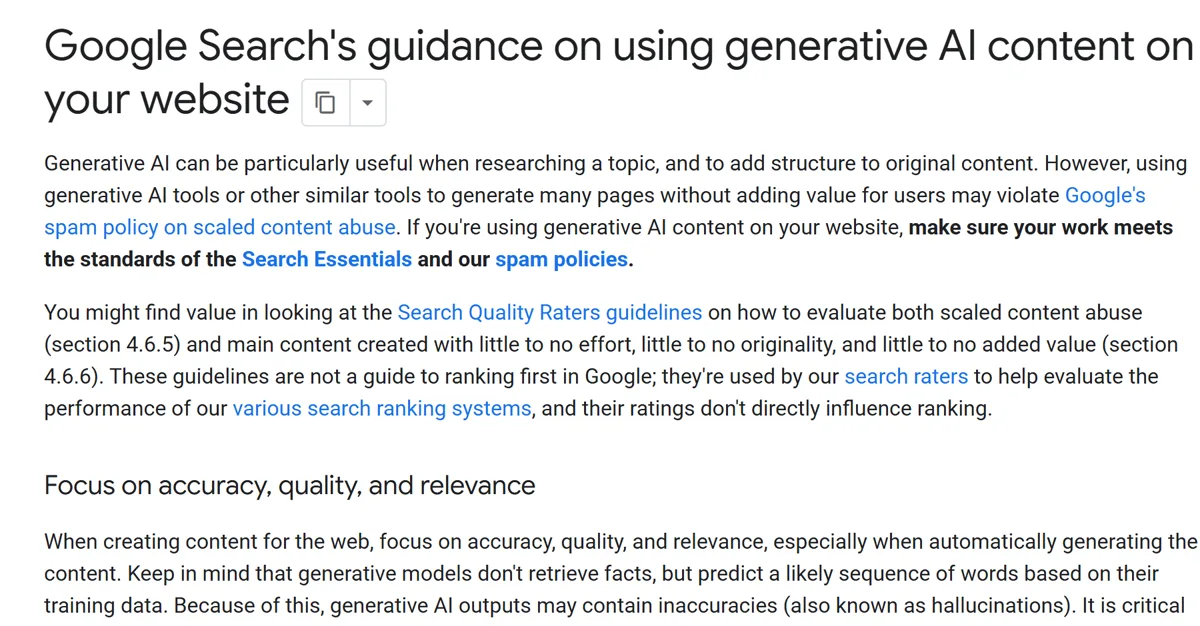
1. Google’s guidance on generative AI content. Google’s page on using generative AI content says generative AI can be useful for research and for adding structure to original content.
It also says that producing many pages with AI tools without adding value for users may violate its spam policy on scaled content abuse.
It tells creators to focus on accuracy, quality and relevance, and it explains why: generative models “don’t retrieve facts, but predict a likely sequence of words,” so they can produce hallucinations, meaning confident statements that are false.
Its advice is to manually review and fact check AI content before publishing. The same review applies to title elements, meta descriptions, structured data and image alt text, because these can appear in Search.
2. The spam policy on scaled content abuse. In Google’s spam policies on Search Central, scaled content abuse means many pages generated mainly to manipulate search rankings and not to help users.
The policy says this applies “no matter how it’s created.”
Its list of examples includes using generative AI tools to generate many pages without adding value for users, but also scraping content, stitching together text from other pages, and creating pages that make little sense to a reader but contain search keywords.
So AI is named as one way to break the rule, not the only way.
3. Google’s earlier statement on AI and rankings. In its February 2023 Search Central blog post on AI content, Google says automation has long been used to produce helpful content such as sports scores, weather forecasts and transcripts, and that using automation mainly to manipulate rankings breaks its spam policies.
It also advises disclosure and bylines where readers would reasonably expect them, and says listing AI as an author is discouraged.
What the evidence does not tell us is how well any detection works or how many pages are affected in practice. The Google pages above do not say. Anyone who tells you a specific “AI detector score” will keep you safe is guessing.
What this means for you: Use AI as a drafting tool, and make sure a person adds value, checks facts and answers for every page.
Does AI content actually rank, and what happens to clicks?
Policy tells you the rules. Data tells you what is happening on results pages. Two large sources are worth knowing, and both have limits.
Both are published studies, so the figures are confirmed by their authors, but neither proves cause and effect.
In July 2025, Ahrefs analysed the top 20 results for 100,000 random keywords, about 600,000 pages, using its own AI content detector.
It found that 13.5% of those pages were purely human written, 4.6% were purely AI, and 81.9% were a mix. The link between how much AI a page contained and where it ranked was 0.011, which Ahrefs describes as effectively zero.
Ahrefs also notes that no detector is perfect and that the number one position tended to have slightly less AI content, though the pattern was very weak.
- Purely human13.5% of pages
- Minimal AI (1 to 10%)13.8% of pages
- Moderate AI (11 to 40%)40% of pages
- Substantial AI (41 to 70%)20.3% of pages
- Dominant AI (71 to 99%)7.8% of pages
- Purely AI4.6% of pages
Source: Ahrefs study of about 600,000 pages, July 2025
Read this carefully. It says that AI assisted pages rank. It does not say AI made them rank, and it does not tell you how many AI heavy pages never reached the top 20. It is a snapshot from one vendor’s tool.
The second source is about clicks.
In a July 2025 Pew Research Center analysis of 900 US adults whose browsing was tracked in March 2025, people clicked a regular result link in 8% of visits to Google results pages that showed an AI summary, and in 15% of visits to pages without one.
Links inside the summary itself were clicked in 1% of visits.
- With an AI summary8% of visits
- Without an AI summary15% of visits
Source: Pew Research Center, 900 US adults, March 2025
About 18% of the 68,879 unique searches in the study produced an AI summary. This covers Google, US adults and one month only, so do not assume it holds in your country.
Separately, in a Pew survey of 5,123 US adults (24 February to 2 March 2025), 34% had used ChatGPT. Among adults under 30 the share was 58%, up from 43% in 2024 and 33% in 2023.
- 202333% who have used it
- 202443% who have used it
- 202558% who have used it
Source: Pew Research Center survey of 5,123 US adults, 2025
That is why many of your customers may meet your business through an AI answer, which is a topic for AEO and GEO explained. Whether these US figures apply where you trade is not known from this data.
What this means for you: Do not worry about an AI label. Watch your own Search Console clicks, because AI summaries may be changing how many visits you get.
How do EEAT and helpful content apply?
Google’s Search Central guidance on creating helpful content uses the term E E A T: Experience, Expertise, Authoritativeness and Trust. Two points from it are easy to miss.
- Google says EEAT is not itself a specific ranking factor. It is a way of describing signals that tend to go with helpful content.
- Of the four, Google says trust is most important.
The same page suggests asking three questions about your content. Who made it, so readers can see a real author and background. How was it made, including any automation, with a disclosure where readers might wonder.
Why was it made, which Google calls perhaps the most important question: to help people, or to attract search traffic.
It also warns against fabricating author profiles, and describes using generative AI to produce large amounts of text without manual oversight or curation as low effort.
The practical reading is simple. A model has no experience of running your shop, treating your patients or installing your boilers. You do. The experience part of EEAT has to come from you, and it is exactly the part AI cannot fill in.
What this means for you: Before you prompt anything, write down one real example, number or photo from your own work that the page must include.
What is AI good at in SEO work?
These uses save time and carry low risk, because a human can check the output quickly.
- Research support. Listing the subtopics a page on your service should cover, or the questions a buyer might have. Treat the list as prompts for you to check, not as facts.
- Outlines. Turning your notes into a heading structure.
- Summarising. Condensing a long report, a call transcript or a pile of customer emails so you can spot patterns.
- Schema drafts. Drafting JSON-LD structured data, which you then validate with Google’s tools.
- Spreadsheet and regex help. Writing a formula, cleaning a list of URLs, or creating a redirect pattern.
- FAQ drafting. Proposing questions, which you answer from your real knowledge.
- Editing. Tightening sentences, checking reading level, spotting repetition.
What this means for you: Start with the safe tasks at the top of the scale, where a quick human check is enough.
Where does AI fail?
- Invented facts. Because models predict likely words, they will produce plausible statistics, quotes and sources that do not exist. Google says as much on its own page.
- Generic text. Ask for “a blog post about plumbing in Leeds” and you get what everyone else gets. That is a poor foundation for a page that has to be better than what already ranks.
- Outdated information. Models can reflect old data, old prices and old platform rules. Anything that changes needs a primary source.
- No first hand experience. No photos, no real examples, no lessons learned from a job gone wrong.
- No accountability. The model does not know your legal or professional obligations. If the page gives health, legal or money advice, you carry the risk.
What this means for you: Never publish a number, quote or source from AI until you have found it on the original page yourself.
How do you use AI safely, step by step?
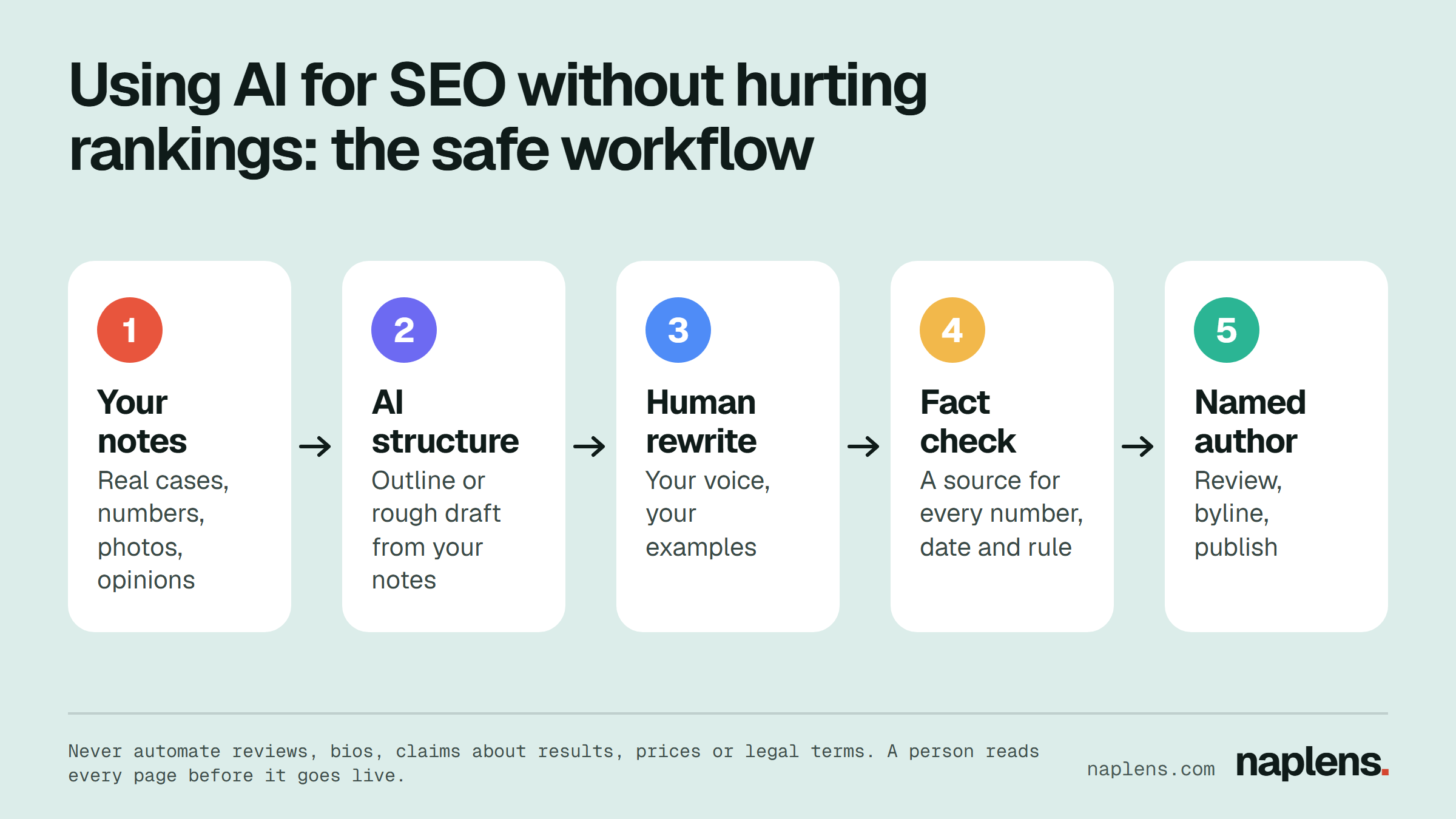
- Start with a human decision. Pick the topic because customers need it, not because a tool can generate it quickly.
- Add your own material first. Write down what you know: real cases, numbers from your own work, photos, opinions, mistakes. This is your experience, and it is what makes a page different.
- Use AI for structure or a rough draft. Give it your notes, not just a topic.
- Rewrite in your voice. Cut generic filler. Add the examples only you have.
- Fact check every claim. Anything with a number, date, price, law or platform rule needs a primary source. If you cannot find one, delete the claim.
- Check the extras. Titles, meta descriptions, alt text and structured data, because Google says they need the same care.
- Put a real author on it. A named person with a real background, and a short note on how AI was used where that helps the reader.
- Publish less, better. One page that helps beats ten that fill space.
Which SEO tasks are safe to give AI?
| Task | Rating | Why |
|---|---|---|
| Brainstorming topics and questions | Safe | You decide what to use |
| Summarising your own documents | Safe | Check that nothing is distorted |
| Spreadsheet formulas, regex, redirect patterns | Safe | Test on a small sample first |
| Keyword grouping | Review needed | Groups can mix different search intent |
| Title and meta description drafts | Review needed | Must be accurate, unique and not misleading |
| Outlines | Review needed | May copy the same structure as everyone else |
| Schema markup drafts | Review needed | Validate and make sure it matches visible page content |
| FAQ drafts | Review needed | Answers must come from your real knowledge |
| First drafts of articles | Review needed | Needs your experience, facts and voice |
| Statistics, quotes, citations | Avoid | Models invent them; use a primary source |
| Health, legal, financial advice | Avoid | Needs a qualified human |
| Bulk pages from a template with AI filler | Avoid | The pattern Google names as scaled content abuse |
| Fake reviews, author profiles or testimonials | Avoid | Deception destroys trust |
| Publishing with no human review | Avoid | Google describes this as low effort |
What should you never automate?
Reviews and testimonials, author bios and credentials, claims about results, prices and legal terms, and anything where being wrong could harm a customer. Also do not automate publishing. A person should read every page before it goes live.
What this means for you: Make a short list of what only a named person on your team may write or approve, and keep to it.
What prompts can you copy?
These are starting points. Replace the text in square brackets. Always check the answers.
Keyword clustering
`I will paste a list of search phrases for [type of business] in [location]. Group them by what the searcher wants: learn, compare, buy, or find a local provider.
Give each group a name and say which phrases could share one page and which need separate pages. Do not add phrases I did not give you. List: [paste list]`
Title and meta description drafts
Here is my page content: [paste]. Write 5 title options under 60 characters and 3 meta descriptions under 155 characters. Use only facts that appear in the content. Do not promise results. Write in plain language.
FAQ ideas
I run [business]. List 15 questions a customer might ask before buying [service]. Group them by stage: before contacting us, during the job, after. I will write the answers myself, so do not answer them.
Checking a draft for unsupported claims
`Read the draft below. List every sentence that contains a statistic, date, price, law, platform rule, guarantee, or claim of results. For each, say what kind of source would prove it.
Do not confirm any claim yourself and do not add new facts. Draft: [paste]`
The last prompt does not replace checking. It only gives you a to do list for your own fact checking.
Does using ChatGPT change how AI answers show my business?
Using ChatGPT to help write is a separate question from being cited by ChatGPT.
The second is about how AI tools choose sources, and we cover it in AEO and GEO explained and how businesses show up in ChatGPT.
For a wider view of whether the effort pays off, see is SEO worth it for small business.
What this means for you: Treat writing with AI and being cited by AI as two separate jobs, and plan for each one.
Frequently asked questions
Is ChatGPT good for SEO?
It is good for support tasks such as research, outlines, summaries, formulas and drafts of structured data. It is not good at producing finished pages on its own, because it can invent facts and lacks your first hand experience.
Google’s own guidance asks for human review and fact checking.
How to use ChatGPT for SEO?
Give it your own notes and ask for structure, groupings, drafts or checklists, then edit and verify the result. The prompts above cover keyword grouping, titles and meta descriptions, FAQ ideas and a claim check.
Keep a person responsible for every page.
Does Google penalize AI content?
Google says AI content is not penalised because of the tool. Content created mainly to manipulate rankings, including many AI generated pages that add no value, can violate its scaled content abuse policy.
Helpful, accurate, reviewed content is treated like any other content.
Can Google detect AI content?
The Google pages above do not describe any detection method, and its policies focus on purpose and value, not the tool. Its guidance is to focus on quality however content is produced. Trying to disguise low value pages is not a plan.
Will AI content rank?
It can, if it is useful and original, and it may not if it is not. Google says using AI gives no special gain. Nobody can promise a ranking for any page, human written or AI assisted.
Should I tell readers I used AI?
Google says sharing how content was created can give readers helpful context, and suggests disclosure where readers might wonder. It is a recommendation, not a stated requirement. A named human author remains important.
If you would like help using AI in your SEO without the risk, with a person checking the facts and the structure, our SEO and AI visibility service covers technical SEO, content and tracking.
We are happy to talk it through first.

Written byEugene CudjoeCOO, Naplens DigitalRuns operations at Naplens Digital and leads its SEO and AI search work. Holds Google Ads, HubSpot Academy and McKinsey generative AI certifications, with six years across B2B, SaaS and e commerce.