On this page
SEO is worth it for a small business when three things are true: people already search for what you sell, the average customer is worth enough to cover months of work before the first return, and you can afford to wait.
When any of those is missing, it is often the wrong first move. It is not dead, and it is not a sure thing. It is a slow, compounding channel that suits some businesses well and others badly.
AI answers have changed the maths a little, not erased it. Fewer searchers click when an AI summary appears, but Google says no special optimisation is needed to appear in those summaries, and ordinary good SEO still applies.
The rest of this post gives you a worksheet to test the question against your own numbers, instead of taking anyone's word for it, including ours.
What does SEO actually deliver?
SEO (search engine optimisation) is the work of making your website easy for search engines to find, understand and trust, so it can appear when people search for what you offer. Done well, it delivers:
- Visitors who are already looking for your product or service, which is why the enquiries tend to be warm.
- A channel you do not pay for per click. You still pay for the work, but a page that ranks keeps working without a per visit bill.
- Compounding assets. A useful page, a strong local profile or a good mention on a respected site can keep helping for a long time.
This is how SEO is widely described, and Google’s own guidance supports the basics. How much it delivers for you is not known in advance, because it depends on your market.
What this means for you: Write down which of these three benefits you actually need, so you can judge any proposal against it.
What does SEO not deliver?
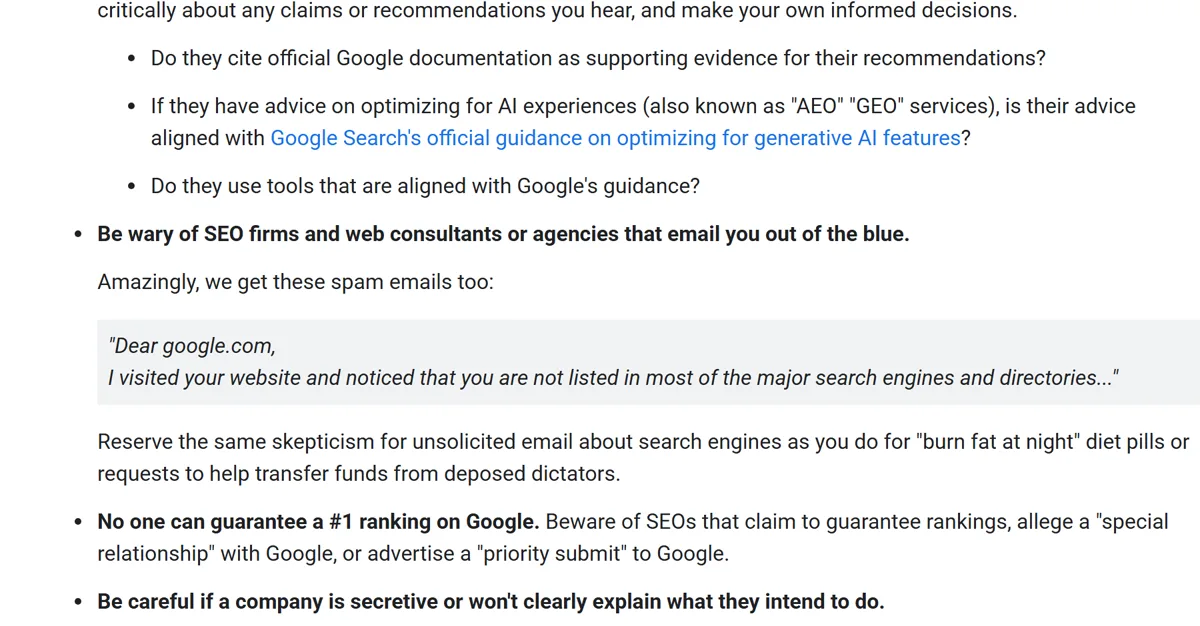
- A guaranteed ranking. Google states plainly: “No one can guarantee a #1 ranking on Google.” Its SEO starter guide adds that there are “no secrets here that’ll automatically rank your site first in Google.”
- Fast results. More on timing below.
- Demand that does not exist. SEO can only capture searches people already make. If nobody types your service into Google, there is nothing to capture.
- A fix for a weak offer or a weak website. If visitors arrive and do not enquire, ranking higher just sends more people to the same problem. Our post on why your website is not getting enquiries covers that.
What this means for you: Ask any provider which of these four limits applies to you before you agree to anything.
Does SEO still work now that AI answers exist?
The questions people type into Google include “does SEO work anymore” and “is SEO obsolete”. Here is what the evidence supports.
In a 2025 Pew Research Center study, 900 US adults had their real browsing tracked in March 2025, covering 68,879 Google searches. This is confirmed by Pew’s published method.
When a visit included an AI summary, the person clicked a traditional result link in 8% of visits. When there was no AI summary, it was 15% of visits.
Clicking a link inside the AI summary itself happened in just 1% of visits to pages that had one.
You can read the method in Pew’s write up.
- With an AI summary8% of visits
- Without an AI summary15% of visits
Source: Pew Research Center, 900 US adults, March 2025 browsing
Read that carefully. It is a US study of Google users from one month. It does not tell you what happens for your type of search, your country, or searches with strong buying intent, and it does not mean search traffic is gone.
It does mean that, for the searches that trigger a summary, fewer people click.
Google’s own guidance, on its AI features page, says AI Overviews appear when its systems judge they add value, so they often do not appear.
It says: “There are no additional requirements to appear in AI Overviews or AI Mode, nor other special optimizations necessary.”
A page still has to be indexed and eligible to show with a snippet, and Google says appearing is never guaranteed. Google also says visits from AI features are counted in the normal Web search type in Search Console.
Google claims those clicks tend to be higher quality. That is Google’s own statement, and independent data on it is not known to us.
What this means for the maths:
- Assume less traffic per ranking than the old rules of thumb for informational searches, such as “what is” questions.
- Value searches with clear buying intent more, such as “plumber near me” or “book a wedding photographer”. These are the searches a worksheet should focus on.
- Treat being named or cited by AI tools as an extra, not a replacement. Our post on AEO and GEO explains how that works.
What this means for you: Pick the three searches that would bring you a paying customer and judge SEO only against those.
Will SEO pay back for my business?
Do this on paper. Use your own numbers, and be pessimistic where you are unsure. The example figures below are illustrative only and use a made up currency, “units”.
| Step | Question | Illustrative example |
|---|---|---|
| 1 | What is one new customer worth in profit, not revenue, over their time with you? | 300 units |
| 2 | Out of 100 enquiries, how many become paying customers? | 25 |
| 3 | So one enquiry is worth (step 1 multiplied by step 2, as a share) | 75 units |
| 4 | What would SEO cost per month, all in (agency, tools, your time)? | 500 units |
| 5 | Enquiries per month needed to break even (step 4 divided by step 3) | about 7 |
| 6 | How many people search for what you sell each month where you work? | You must check this |
| 7 | How many months can you pay before you need a return? | 6, 9, 12? |
| 8 | Could you survive if it returned nothing for that long? | Yes or no |
How do I fill in the harder rows?
- Step 1 and 2: Use real records. If you do not track close rate, that is your first job, and it is free. Count enquiries and sales for three months.
- Step 6: Type your main services and your town or region into Google and watch the suggestions. Use Google’s free Keyword Planner (inside a Google Ads account) or Search Console if you already have a site. Treat any tool’s numbers as rough estimates. If you find only a handful of relevant searches a month, SEO has little room to work.
- Competition: Search your main phrases yourself. If page one is full of national brands and large directories, you are competing with budgets far bigger than yours. If it is mostly weak or outdated local sites, there is room. BrightLocal’s 2026 Local Consumer Review Survey of 1,002 US adults found that Google’s share as a place to read reviews dipped from 83% in 2025 to 71%, so reviews and your Google profile matter and other platforms are growing. That is a US figure about reviews, not all local search. Judging competition is still a judgement, not a number, and an honest agency should tell you which case you are in.
- Step 7 and 8: Be realistic. Write down the cash you can commit without putting payroll or stock at risk.
- 202583% of US consumers
- 202671% of US consumers
Source: BrightLocal Local Consumer Review Survey 2026, 1,002 US adults
How do I read my result?
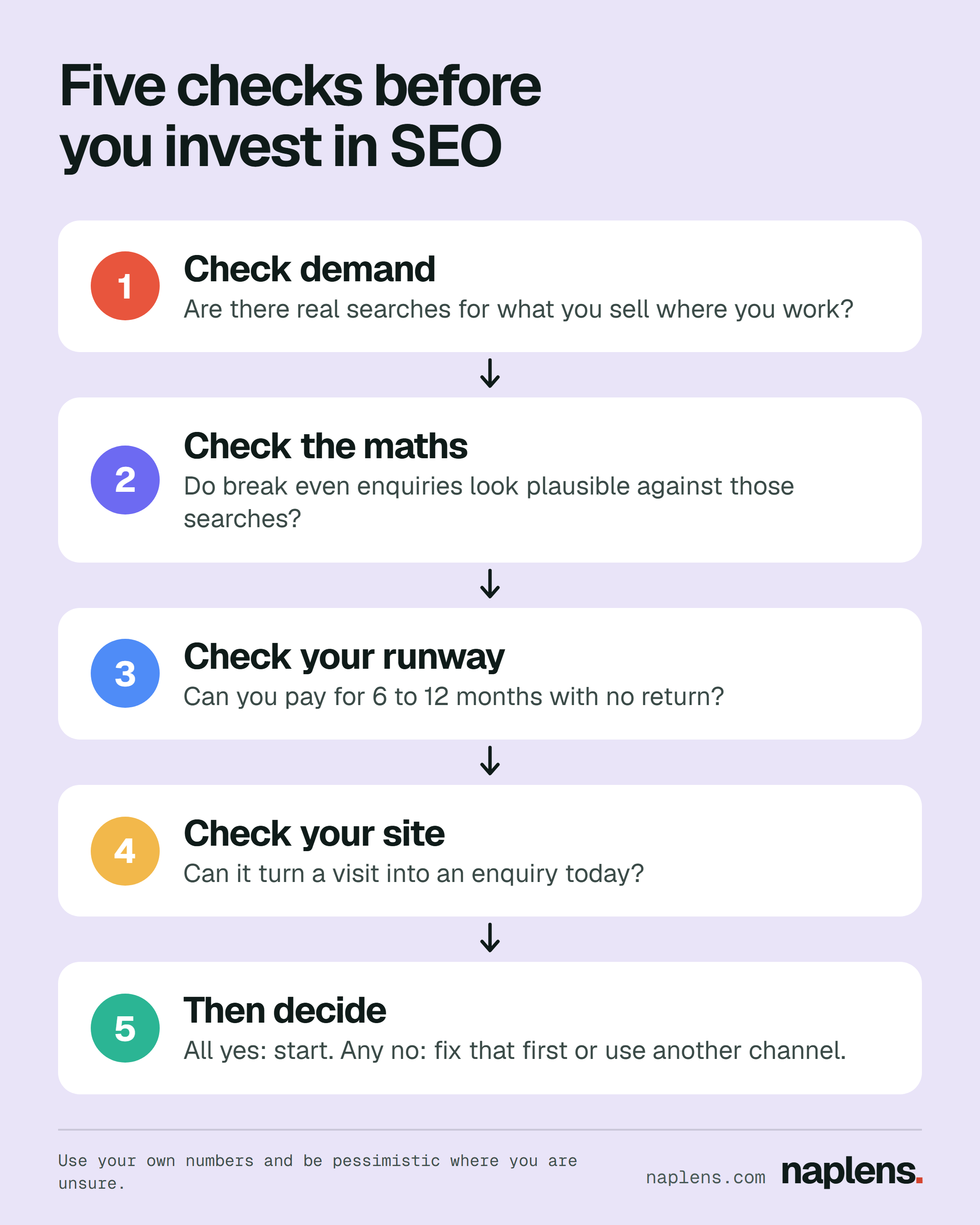
- Break even needs a few enquiries a month and searches exist: SEO is worth a serious look.
- Break even needs more enquiries than the searches could plausibly produce: SEO alone will not pay. Look at other channels first.
- Customer value is low and the close rate is low: the maths is hard. Fix the offer or follow up first.
- You cannot wait the time it takes: do not start. A half finished SEO project that stops after three months has usually paid for work whose return would have come later.
What this means for you: Write your break even number in step 5 today, then check it against real search demand before talking to any agency.
How long does SEO take?
This is the most common honest answer people avoid.
Google says in its starter guide: “Some changes might take effect in a few hours, others could take several months,” and suggests you likely want to wait a few weeks before judging whether a change helped.
Google does not give a single timeline for results, and neither can anyone else, because it depends on your site’s age, your competition and the quality of the work.
Ahrefs, an SEO software company, studied how new pages perform. In a 2025 Ahrefs analysis of 1 million random pages first seen in September 2023, only 1.74% of newly published pages reached the top 10 of Google within a year.
A second sample of 2 million English pages created in October 2023 gave 6.11%, which the authors say may be the fairer figure. Treat both as a sign that most new pages do not reach page one quickly, and note the two samples disagree.
The same study found 40.82% of pages that did reach the top 10 got there within a month, and that 72.9% of top 10 pages for 1.3 million US keywords were more than 3 years old.
Ahrefs also reports 13.7% of top 10 pages were under 1 year old, down from 22% in its 2017 study. Established sites have a head start. These figures are confirmed by the published study, but they describe Ahrefs’ samples, not every market.
You can read the full Ahrefs study.
- Under 1 year old13.7% of top 10 pages
- Over 3 years old72.9% of top 10 pages
Source: Ahrefs study of 1.3 million US keywords, 2025
A sensible way to plan, as a framework and not a promise:
- Month 1 to 2: audit, fixes, setup. Almost no visible return. This is normal.
- Month 3 to 6: early movement is possible, especially for local and low competition searches. Do not judge the whole project yet.
- Month 6 to 12: this is where a fair judgement can usually be made, by looking at enquiries and not only positions.
If your worksheet needs a return inside three months, SEO is the wrong tool. Paid ads are built for that.
What this means for you: Set a review date at month six and judge by enquiries, and do not start if you cannot fund the whole stretch.
Who should not invest in SEO yet?
- A business with no clear offer or price. Fix that first.
- A site that cannot take enquiries. If the phone number is wrong, the form is broken or the site is not mobile friendly, repair that before paying for traffic.
- Businesses with almost no search demand. Some niches grow through referrals, relationships or social media instead.
- Owners with no runway. If you need customers this month, SEO is not a rescue plan.
- Anyone who will not track enquiries. Without tracking, you cannot know if anything worked.
Google itself notes that if you run a small local business, you can probably do much of the work yourself, and that hiring help makes the most sense when you are redesigning or launching a site, ideally early.
Its guidance on whether you need an SEO is worth reading in full before you spend anything.
What this means for you: If one of these five fits you, fix that first and revisit SEO in a few months.
How does SEO compare with paid ads?
| SEO | Paid ads | |
|---|---|---|
| Speed | Slow to start | Can start within days |
| Cost pattern | Work up front, then lower cost per visit if it ranks | You pay for every click, and stop paying when you stop |
| What it builds | Lasting pages and profiles | Nothing that stays once the budget ends |
| Risk | Slow or no return if demand is thin | Money spent on clicks that do not convert |
| Best for | Long term, steady demand | Fast tests, launches, short windows |
Many small businesses sensibly use both: ads to learn which searches and messages bring customers, then SEO to build the same pages over time.
We compare them in more depth in SEO vs Google Ads vs Meta Ads.
What this means for you: If you need customers within weeks, test with a small ad budget first and let that data decide where SEO effort goes.
How do I judge an agency’s reporting?
A report full of keyword positions can look impressive and still mean nothing for your till.
Google suggests asking any SEO: “How do you measure your success?”, “What kind of results do you expect to see, and in what timeframe?” and “Will you share with me all the changes you make to my site?” Use a short checklist:
- Enquiries first. Calls, form submissions, direction requests and bookings that came from search, month by month.
- Real customers. Ask which enquiries became sales. Rankings are a leading signal, not the result.
- Search Console data. Impressions, clicks and the queries behind them, from your own account that you own.
- A change log. A plain list of what was changed and why.
- Honest ranges. No guarantee of first place. Google says: “If they guarantee you that their changes will give you first place in search results, find someone else.”
- No pressure tactics. Google warns against agencies that email you out of the blue, are secretive about their methods, or push link schemes.
What this means for you: Ask for last month’s enquiries from search before you ask for rankings, and refuse any report that cannot show them.
Frequently asked questions
Is SEO worth it for small business?
It can be, if people already search for what you sell, a new customer is worth enough to repay months of work, and you can wait. Use the worksheet above to test it with your own numbers.
If it does not add up, a different channel is the better choice.
Is SEO worth it in 2026?
Search still sends visitors, but AI summaries reduce clicks on some searches. A US Pew Research study found people clicked a regular result in 8% of visits with an AI summary against 15% without one.
The searches that matter most are the ones with clear buying intent, so measure those.
Does SEO work anymore?
Yes, in the sense that pages still earn visits from search and Google says standard SEO practices still apply for AI features too. What no longer holds is the idea that a ranking guarantees traffic. Judge SEO by enquiries, not rankings.
How long does SEO take to work?
Google says some changes take effect in hours and others can take several months, and that you should wait a few weeks before judging a change.
For planning, think in terms of 6 to 12 months before a fair verdict, and treat that as an estimate, not a promise.
How much does SEO cost for a small business?
It varies widely by country, competition and scope, so we will not quote a single figure. Get at least two written proposals that list the work, the reporting and the timeframe, and put the monthly cost into step 4 of the worksheet.
If you would like a second opinion on your own numbers, our SEO and AI visibility service starts with a free audit of where you stand on Google and in AI answers.

Written byEugene CudjoeCOO, Naplens DigitalRuns operations at Naplens Digital and leads its SEO and AI search work. Holds Google Ads, HubSpot Academy and McKinsey generative AI certifications, with six years across B2B, SaaS and e commerce.