On this page
- What do people ask Google about this?
- How does each channel work?
- Should I target people who are searching or people who are scrolling?
- How long do SEO, Google ads and Meta ads take?
- Is it better to pay per click or build an asset?
- What tracking do I need before I spend?
- When does each channel fail?
- Which channel should my type of business start with?
- What should I do in the first 90 days?
- Frequently asked questions
If people already search for what you sell and you need enquiries soon, start with Google search ads while you build SEO alongside.
If nobody searches for what you sell yet, or you sell something people discover rather than look for, Meta ads (Facebook and Instagram) are the better first test.
If you can wait months and your budget is small, SEO is the cheapest long term asset, but it is the slowest and the least certain.
There is no single winner, because the three channels do different jobs. SEO and Google search ads catch people who are already looking. Meta ads interrupt people who are scrolling.
The right first spend depends on your customer’s intent, how fast you need results, what you can afford to lose while you learn, and whether you can track what happens.
These numbers describe SEO, and they are a reminder that unpaid search is slow and uneven. They do not mean SEO is pointless. They mean it rewards patience and quality, and that pages nobody maintains rarely get anywhere.
What do people ask Google about this?
Questions people type into Google when they compare the options include “seo vs google ads which is better”, “seo vs google ads which should you invest in first”, “is google ads worth it for small business”, “how long does google ads take to work” and “meta ads for small business”.
This guide answers them in order.
What this means for you: Decide what you are really asking: where to start, how fast you need results, or whether you can afford to wait.
How does each channel work?
How does SEO work?
SEO means improving your website and your presence so you appear in Google’s unpaid results.
Google’s Search Essentials page says it does not cost money to appear there: “It doesn’t cost any money to appear in Google Search results, no matter what anyone tries to tell you.”
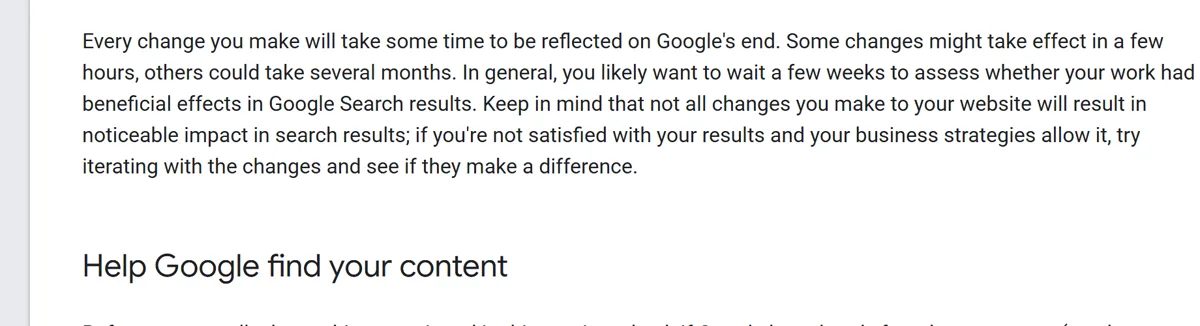
On timing, Google’s SEO Starter Guide is honest about the wait: “Some changes might take effect in a few hours, others could take several months,” and it suggests waiting a few weeks before judging whether your work helped.
So you pay for the work (your time, a writer, a developer or an agency), not for each visit. When a page ranks, visits keep arriving without a per click bill. That is the “asset” side.
The cost side is that no one can promise a ranking or a date.
Ahrefs’ studies show how uneven the results are.
In a December 2023 analysis of its Content Explorer database (about 14 billion pages), 96.55% of pages got zero traffic from Google; Ahrefs notes the database may lean toward higher quality sites, so treat it as a rough picture.
In a study of 1 million random URLs seen by its crawler in September 2023 (published May 2025), only 1.74% of newly published pages ranked in the top 10 within a year, and a second filter on English content created in October 2023 gave 6.11%.
The two figures differ because the method differs, so read them as “a small minority”.
The same research found that 72.9% of pages in Google’s top 10 were more than 3 years old, and that the average number one page was 5 years old (1.3 million random US keywords).
These are confirmed by Ahrefs’ own pages, though they come from one company’s crawler. Read the full Ahrefs ranking time study for the method.
The lesson for a small business: SEO is a patient bet on a few pages that are genuinely better than what exists, not a bet on volume.
How do Google search ads work?
Google Ads runs an auction every time someone searches. Google describes “a lightning fast ad auction, that takes place every time someone searches on Google.” Your bid is the most you are willing to pay for a click, and you often pay less.
Google lists six main factors that decide which ads show and in what order: your bid, ad and landing page quality, the expected effect of ad assets and formats, minimum quality thresholds, the context of the search (terms, location, device, time), and how competitive the auction is.
See Google’s own explanation of how the ad auction works.
The practical meaning: money alone does not win. A relevant ad pointing to a useful landing page can beat a bigger bid. It also means a weak website wastes your budget, because the page the click lands on is part of the score.
Budget works as an average.
According to Google Ads Help, your daily spend can go over or under your daily budget on a given day, with a daily limit of two times the average daily budget for most campaigns and a monthly limit of 30.4 times it.
A budget of 10 a day therefore means about 304 in a month, and up to 20 on a single day. Plan for the monthly figure, not the daily one. This is confirmed on Google’s budget help page.
How do Meta ads work?
Meta ads show in feeds, stories and similar places to people who were not searching for you. You choose a goal (messages, leads, sales, traffic) and Meta’s delivery system tries to find people likely to do that.
Meta’s help pages are widely reported to describe a learning period in which the delivery system is exploring how best to deliver your ads, performance is less stable and cost per result is usually worse.
The figure often cited is roughly 50 optimization events after an ad set’s last significant edit.
We could not confirm the exact wording on a Meta page that loaded, so treat that number as unconfirmed and check Meta’s current help pages, because these rules change.
A tiny budget aimed at a rare action (like a high priced purchase) may not give the system enough events to settle. Changing the audience, creative or optimization event can restart learning, so change one thing at a time and be patient.
What this means for you: Choose one channel to learn first, and judge SEO by months, Google ads by planned test windows and Meta by whether the system had enough results.
Should I target people who are searching or people who are scrolling?
This is the biggest difference and the one most owners skip.
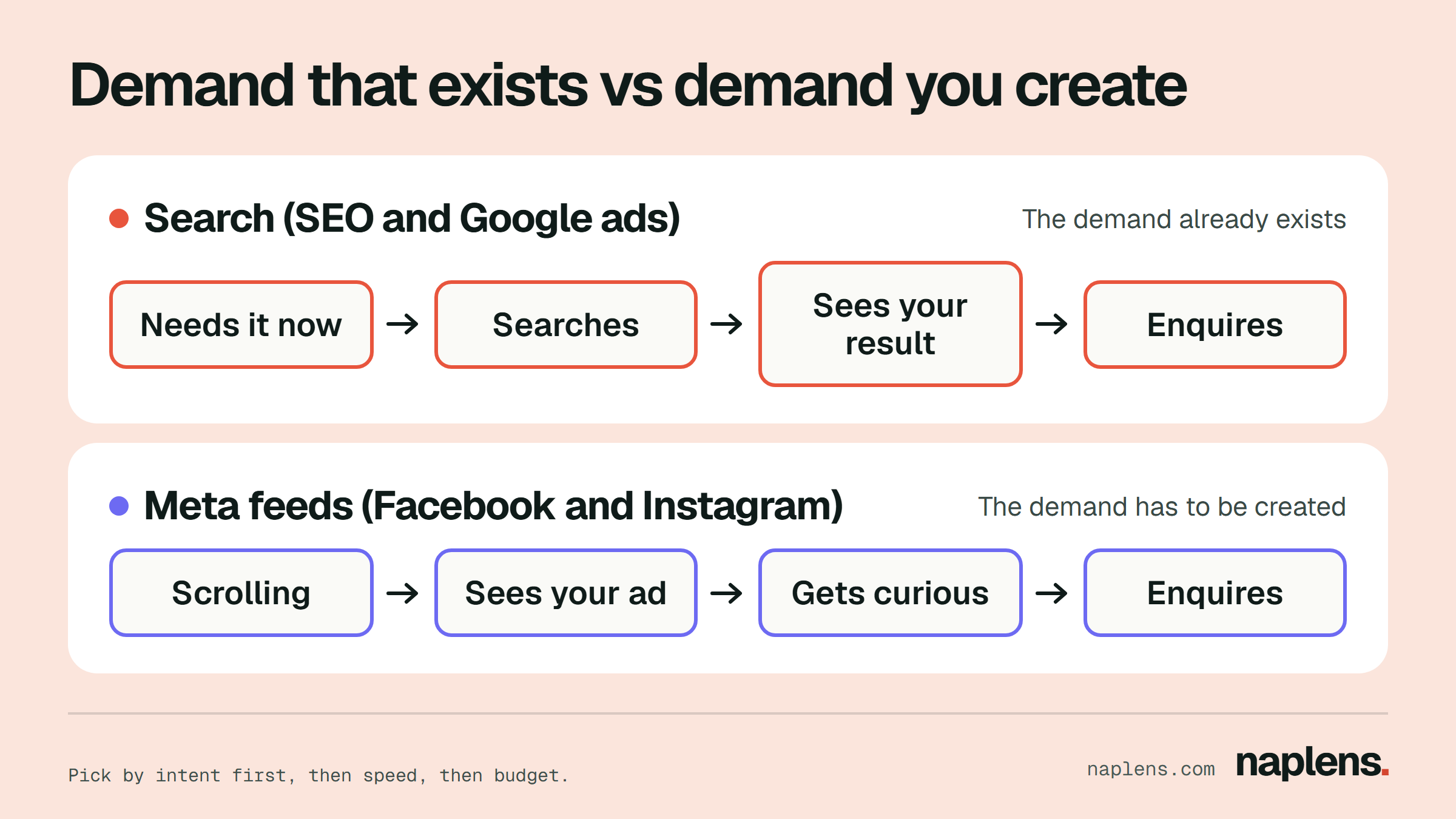
- Search (SEO and Google ads). The person typed a need: “plumber near me”, “wedding photographer prices”, “accounting software for small teams”. They are already in the market. You are not creating desire, only being there and being believable.
- Feeds (Meta). The person was looking at friends’ photos. You earn a moment of attention with a picture, a video and a message. This works well for things people did not know they wanted, for visual products, for events and for building an audience. It works poorly when you need people who are ready to buy this week and cannot show them why in a few seconds.
Neither is “better”. A bakery selling birthday cakes might find searchers (“birthday cake delivery”) convert faster, while a new snack brand has few people searching its name and needs the interruption to be found at all.
One change to watch: AI summaries in Google results.
In Pew Research Center’s July 2025 analysis of browsing data from 900 US adults (March 2025) covering 68,879 unique Google searches, people clicked a traditional result in 8% of visits when an AI summary appeared, against 15% when it did not.
Only about 1% of visits with a summary included a click on a link inside the summary. Pew’s page confirms these figures. They apply to US Google users in that month and should not be stretched to every country.
- Without an AI summary15%
- With an AI summary8%
Source: Pew Research Center, 900 US adults and 68,879 Google searches, March 2025
What this means for you: Match the channel to the intent of your buyer, and do not depend on a single source of visits.
How long do SEO, Google ads and Meta ads take?
| Typical pace | What you wait for | |
|---|---|---|
| SEO | Slowest. Google says changes can take hours to several months | Pages to be found, understood and trusted |
| Google search ads | Fastest to start, once your ads are approved and tracking is on | Enough clicks to judge, then refinement |
| Meta ads | Fast to start, but uneven while learning | Enough results for delivery to settle |
This guide gives no average days or costs for any channel. They vary by country, industry and season, and a guessed number would mislead. Treat the first few weeks of paid ads as paid learning, not proof.
The only timing statement confirmed here is Google’s own: SEO changes can take effect in hours or take several months.
What this means for you: Write down how many weeks you can wait for a result, and let that choose your first channel.
Is it better to pay per click or build an asset?
Paid ads are rented attention. You pay per click or per delivery, and when you stop paying, the traffic stops. That is not a flaw; it makes cost predictable and lets you switch it off.
SEO is closer to building a shop in a good location: work now, steady footfall later, but nothing is guaranteed and it needs upkeep.
A fair way to think about it:
- Paid ads convert money into a test. You learn quickly what people click and what they buy. The learning is valuable even if you later move to SEO.
- SEO converts effort into a slowly growing asset. It is poor if you need a result this month.
- Ads can also teach SEO. The search terms that convert in Google ads are good topics for pages.
One honest gap: no primary Google statement is cited here on whether running Google ads changes your organic ranking, so this guide makes no claim either way. Plan SEO as its own project.
What this means for you: Set a spend ceiling for paid ads and a separate weekly hour budget for SEO, and review both monthly.
What tracking do I need before I spend?
Without tracking you are guessing. The basics:
- Google Ads. Google defines conversions as actions you define as valuable, such as a purchase, sign up or phone call. For website actions a tag on your site records the action, and phone call tracking can use a Google forwarding number. Google says to check your tags are correctly implemented, suggests Google Tag Assistant to verify them, and notes that a new tag may show “Unverified” or “Inactive” until a first conversion or successful test event. If you use Google Tag Manager, check the Conversion Linker tag.
- Meta. The Meta pixel is code on your site that reports actions. The Conversions API sends events from your server to Meta. Meta’s developer documentation says server events are processed like pixel events, and that if you already have a pixel you can set up the Conversions API in one click from Events Manager. Meta’s guidance is to use both together, called a redundant setup, with deduplication so one purchase is not counted twice.
- Enquiries that do not happen on your site. If customers call or message you, count those too: use call tracking, a messaging goal, or simply ask every new customer “how did you find us?” and write it down.
If you cannot track at all yet, fix that first. It costs little and it decides whether any later spend is learning or waste. The Google points are confirmed on Google Ads Help and the Conversions API points on Meta’s developer page.
The redundant setup and deduplication advice is widely reported from Meta’s documentation, but we could not confirm the exact wording on a page that loaded.
What this means for you: Make a test enquiry and check it shows up in your reports before you spend anything.
When does each channel fail?
Being even handed means saying where each choice goes wrong.
- SEO fails when you need customers quickly, when your market is dominated by much bigger sites, when nobody can maintain the content, or when you expect a promise of a ranking. No one can honestly give you one.
- Google ads fail when your website is weak or slow, when each customer is worth less than the cost of a click, when you have a tiny budget in a crowded search term, or when few people search for what you sell.
- Meta ads fail when you need people ready to buy today, when the budget is too small for learning to settle, when creative is weak or repetitive, or when tracking is broken so the system optimizes for the wrong thing.
- All three fail if the offer is unclear, the website does not answer buyers’ questions, or nobody replies to enquiries quickly. Fix those before you pay for more traffic.
What this means for you: Before choosing a channel, check your offer, your website and your reply speed, and fix the weakest one first.
Which channel should my type of business start with?
This table is a judgment framework, not research. It reflects reasoning about intent, speed and budget. Your market may differ, so treat it as a starting hypothesis and test it.
| Business situation | Start with | Add next | Why |
|---|---|---|---|
| Local service people search urgently (plumber, locksmith, dentist), modest budget | Google search ads plus a tidy Google Business Profile | SEO and local SEO | Strong intent, and speed matters |
| New product nobody searches for yet, visual or lifestyle | Meta ads (small tests) | SEO content, email list | Demand has to be created |
| Online shop with many products, some budget | Google search ads on best sellers, Meta for discovery | SEO for category and product pages | Mix of intent and discovery |
| Consultant or B2B service with high priced work and a long decision | SEO content and Google search ads on a few exact terms | Meta retargeting of site visitors | Buyers research first and trust matters |
| Very small budget and you can wait | SEO basics and your Google Business Profile | A few weeks of tightly capped search ads to learn terms | Cheapest asset, low risk |
| Event, launch or limited offer with a date | Meta ads | Google search ads for the brand name | Deadline needs fast attention |
| No tracking, no clear offer, slow replies | Fix the website, offer and tracking first | Then any ad | Traffic will leak otherwise |
What this means for you: Find the row closest to your business and treat it as a first test, not a rule.
What should I do in the first 90 days?
This is one example sequence for a business that needs enquiries but has limited money. Adjust it to your own situation.
- 1Days 1 to 14: foundationsWrite your offer in one sentence, set up and test conversion tracking, reply to every enquiry the same day, complete your Google Business Profile
- 2Days 15 to 45: one paid testOne channel chosen from the table, a budget you can afford to lose, one offer, one landing page, few edits
- 3Days 30 to 90: build the assetTurn the search terms and questions that worked into a few useful pages and keep improving them
- 4Day 90: decideKeep what produced customers at an affordable cost, pause or change one variable on the rest
A few notes on each step. In the first two weeks, tracking comes before spend. In the paid test, record cost per enquiry and, more importantly, how many enquiries became customers.
On Google, plan around the monthly limit; on Meta, avoid changing audience or creative every few days, because significant edits can restart learning.
At day 90, if nothing worked, look at the offer, the website and the follow up before blaming the channel.
Frequently asked questions
Is SEO better than Google Ads?
Neither is better in general. SEO builds a slow, lasting source of visits, and Google ads give faster but rented visits. If you need enquiries this month, ads fit; if you can wait and want lower ongoing cost, SEO fits.
Many businesses end up using both.
Is Google Ads worth it for a small business?
It can be, when people search for what you sell, your website converts visitors and each customer is worth more than the click cost to win them. It is a poor fit if you cannot track results or your budget is too small to gather useful data.
Cap your spend and treat the first weeks as a test.
Should I do SEO or ads first?
If you need customers soon and people search for your service, start with a capped search ad test while you begin SEO. If you can wait and money is tight, start with SEO basics and your Google Business Profile.
Either way, set up tracking first.
Is Meta advertising good for small businesses?
It can work well for visual products, events and things people do not already search for. It works less well when you need ready buyers right away or have a budget too small for the system to learn.
Give a test enough time and enough results before judging it.
How long does Google Ads take to work?
Ads can start showing soon after they are approved, but useful results need enough clicks and tracked conversions to judge, which varies by business and budget. There is no official figure to quote, and inventing one would mislead.
Review after a planned test window rather than after a few days.
If you want help choosing and running paid campaigns with the creative, copy and tracking that go with them, our content and ads service is built for that, and our SEO and local SEO service covers the slower, lasting side.
You may also like is SEO worth it for small business and why is my website not getting enquiries.

Written byPriscilla Owusu MensahCMO, Naplens DigitalLeads marketing at Naplens Digital and runs its AI automation and content and ads work. Came to digital from nursing and has trained more than 300 aspiring marketers.